
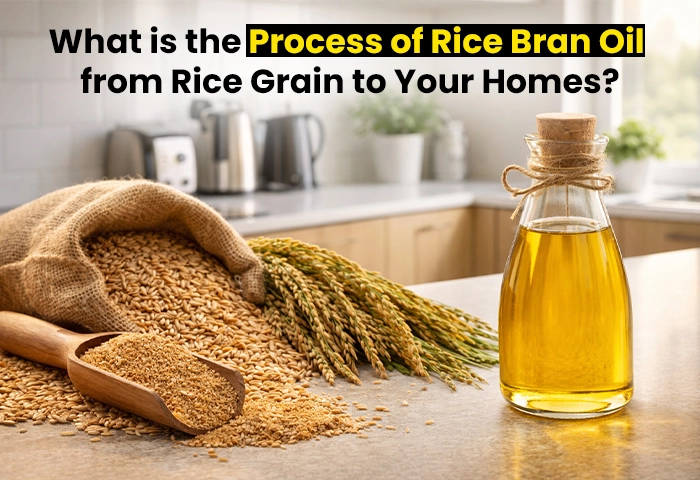
Introduction: The Journey of Rice Bran Oil from Farm to Kitchen
India is the world’s largest producer of rice, and rice is also the most consumed grain in India. Rice is considered one of the most valuable and healthiest sources of cooking oil. As the demand for heart-healthy food is increasing, many people are shifting from their regular oil to rice bran oil due to its health benefits.
Other than olive oil and sunflower oil, there’s also another oil preferred for its nutritional value: rice bran oil. Rice bran oil is utilized in many industries, such as skin care, hair care, and the oil industry.
From the farms to modern manufacturing facilities like Sri Venkatarama Oil Industries (P) Ltd, every step is carefully managed to maintain purity and nutritional value. By the time it reaches your kitchen, rice bran oil has completed a remarkable journey, from rice grain to refined goodness, offering a healthier and smarter choice for everyday cooking.
What is Rice Bran?
Rice bran is the outer layer removed from brown rice during the milling process to produce white rice. It is a highly nutritious byproduct rich in fiber, vitamins B & E, antioxidants, and essential fatty acids such as Mufa & Pufa, often used in food products, supplements, or as animal feed.
However, rice bran is highly perishable due to its natural oil content. If not stabilized immediately after milling, it can spoil quickly. That is why modern processing techniques are used to stabilize rice bran and extract its oil efficiently. The oil obtained from this layer is known as rice bran oil.
Step-by-Step Process: How is Rice Bran Cooking Oil Made?
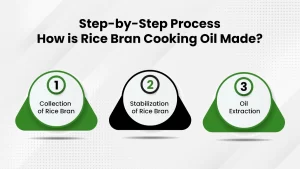
Here is a step-by-step process on how rice bran cooking oil is made:
-
Collection of Rice Bran
- The rice bran is separated from the white rice during milling. This bran is immediately collected because it contains natural oils that can spoil quickly if not processed in time.
-
Stabilization of Rice Bran
- To prevent rice bran from breaking down, the bran is stabilized through heat treatment, ensuring that the nutrients are preserved and the oil remains fresh and suitable for extraction.
-
Oil Extraction
- The stabilized rice bran is then sent for oil extraction. This is typically achieved using a solvent extraction method, where food-grade solvents effectively separate the oil from the bran. The crude rice bran oil obtained at this stage still contains impurities and requires further refining.
People Also Read: Refined Oil Vs Unrefined Oil
Refining Process: Converting Crude Oil into Edible Rice Bran Oil
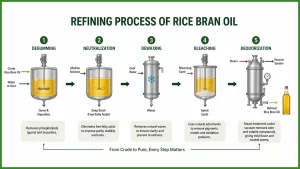
After extracting the crude rice bran oil, here is the process to refine it:
-
Degumming
- During degumming, acid or water is added to remove phospholipids (gums) and impurities from the crude rice bran oil. Degumming ensures a cleaner base for further refining.
-
Neutralization
- During neutralization, an alkaline solution is used to remove these fatty acids, thereby improving the oil’s purity, stability, and taste.
-
Dewaxing
- Rice bran oil naturally contains waxes that can make the oil cloudy, especially in cooler temperatures. Dewaxing removes these waxes, resulting in a clear and visually appealing oil.
-
Bleaching
- Natural adsorbents like bleaching earth are used to remove unwanted pigments, traces of metals, and oxidation products, enhancing the oil’s colour and overall quality.
-
Deodorization
- Finally, the oil is treated with steam under controlled temperature and vacuum conditions to remove any remaining odor or volatile compounds. This gives rice bran oil its mild flavor and neutral aroma, making it perfect for everyday cooking.
People Also Read: Rice Bran Oil for Cooking
Quality Testing & Packaging at SVR Gaia
After refining, every batch undergoes strict laboratory analysis to check parameters such as purity, free fatty acid levels, moisture content, color, and aroma, ensuring that the oil retains essential nutrients like Gamma Oryzanol and Vitamin E while meeting all food safety standards.
Following stringent manufacturing and safety regulations, consistency in taste, texture, and performance is ensured. Each batch is carefully monitored to ensure it delivers the same high quality, stability, and nutritional value that customers expect from a trusted brand like Sri Venkatarama Oil Industries (P) Ltd.
Once approved, the oil is packed using hygienic, automated systems to prevent contamination and preserve freshness. The secure packaging protects the oil from light and air exposure, helping maintain its quality during storage and transportation, ensuring that every bottle of SVR Gaia Rice Bran Oil is safe, pure, and ready for healthy cooking at home.
Nutritional Value Preserved During Processing
Proper heat management and advanced extraction methods help retain nutritionally valuable compounds like Gamma Oryzanol, tocopherols (Vitamin E), and healthy fatty acids such as MUFA & PUFA.
Modern refining techniques are designed to maintain the oil’s antioxidant properties while improving clarity, stability, and shelf life. As a result, high-quality rice bran oil retains its heart-friendly fat profile, antioxidant strength, and high smoke point, making it both nutritionally beneficial and suitable for everyday Indian cooking.
Conclusion: From Rice Grain to Refined Goodness
The journey of rice bran oil from farm to kitchen is a carefully managed process that combines agricultural strength with modern technology. From collecting nutrient-rich rice bran during milling to stabilizing, extracting, refining, and packaging under strict quality standards, every step plays a vital role in delivering safe and healthy cooking oil to your home.
At Sri Venkatarama Oil Industries (P) Ltd, this journey is carried out with precision to preserve essential nutrients like Gamma Oryzanol and Vitamin E while ensuring purity and consistency. The result is refined rice bran oil that supports heart health, offers a high smoke point for Indian cooking, and maintains a light, neutral taste. If you’re still confused, then contact us today.
FAQs: Process of Rice Bran Oil
1. How is rice bran oil made step by step?
Ans: Rice bran cooking oil process includes the steps of collecting rice bran, stabilizing rice bran, and oil extraction, then the refining process that further includes degumming, neutralization, dewaxing, bleaching, and deodorization.
2. What is the raw material for rice bran oil?
Ans: The bran of the rice grain is used as the raw material for rice bran oil.
3. What is another name for rice bran oil?
Ans: Another name for rice bran oil is rice bran carrier oil.