
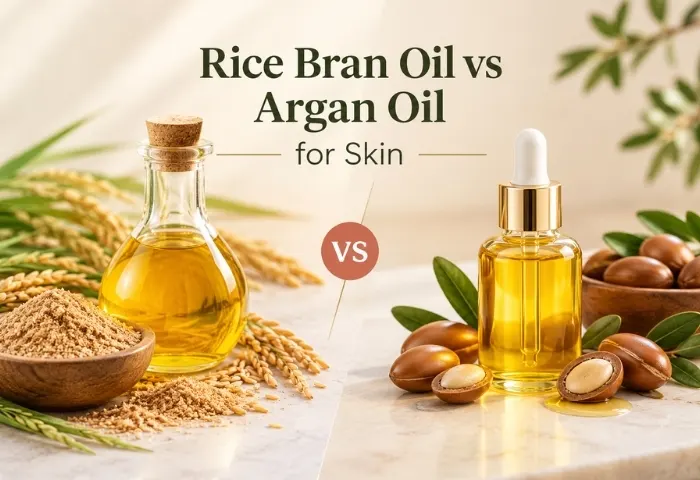
Introduction: Rice Bran Oil vs Argan Oil for Skin
Rice bran oil and argan oil are both plant-based oils used in skincare and cosmetic products for their moisture and natural nutrients. While both can help soften the skin and support its moisture barrier, they differ in their sources, composition, texture, and formulation.
In this blog, we will explore the differences between rice bran oil and argan oil for skin, their uses, benefits, and challenges, and which is better for you.
What Is Rice Bran Oil?
Rice bran oil is extracted from the outer layer of rice grain during rice milling. It contains fatty acids and vitamin E compounds that help condition the skin and support its moisture barrier. It also contains compounds such as tocopherols, tocotrienols, phytosterols, and gamma-oryzanol, which contribute to its nutritional and functional properties.
In skincare products, rice bran oil can be used in moisturisers, creams, lotions, and body oils to help soften the skin and improve its feel. Its suitability depends on the formulation, concentration, and individual skin type.
What Is Argan Oil?
Argan oil is extracted from the kernels of the argan tree and is used in skincare, haircare, and cosmetics because of its moisturising properties and naturally occurring fatty acids and antioxidants.
Argan oil contains fatty acids such as oleic acid and linoleic acid, along with tocopherols, a form of vitamin E, which helps condition the skin, support its moisture barrier, and maintain a soft feel.
In skincare formulations, argan oil is valued for reducing dryness and improving skin softness. However, its performance depends on the product formulation, concentration used, and individual skin characteristics.
Rice Bran Oil vs Argan Oil: Key Differences
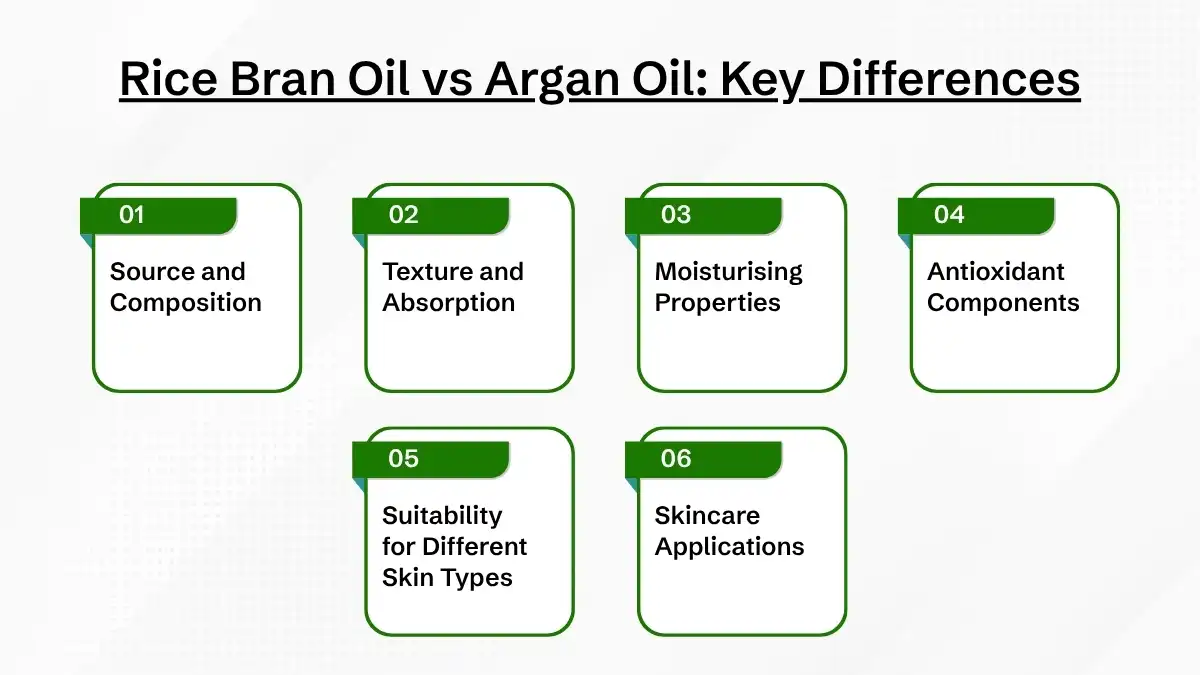
Here are the main differences between rice bran oil and argan oil:
1. Source and Composition
Rice bran oil is extracted from the outer layer of rice grain during rice milling. It contains fatty acids such as oleic acid and linoleic acid, along with naturally occurring compounds like gamma-oryzanol, tocopherols, tocotrienols, and phytosterols.
Argan oil is extracted from the kernels of the argan tree, which is native to Morocco. It also contains oleic acid and linoleic acid, along with tocopherols and other naturally occurring compounds.
2. Texture and Absorption
Rice bran oil generally has a smooth, emollient texture that can work well in creams, lotions, and body oils. Argan oil is also valued for its conditioning properties and is commonly used in facial oils, serums, and moisturisers.
The texture and absorption of both oils can vary depending on their quality, processing methods, concentration, and the other ingredients used in the final skincare formulation.
3. Moisturising Properties
Rice bran oil is suitable for moisturising formulations designed to improve skin softness and smoothness. Argan oil is similarly used in products intended to condition the skin and maintain hydration. The effectiveness of either oil depends on the finished product and individual skin needs.
4. Antioxidant Components
Rice bran oil contains gamma-oryzanol, tocopherols, and tocotrienols, which contribute to its antioxidant profile. These compounds make it a useful ingredient in cosmetic formulations.
Argan oil is known for its tocopherol content and other naturally occurring compounds with antioxidant properties. However, the concentration of these components can vary with sourcing and processing, and their presence does not guarantee specific anti-ageing results.
5. Suitability for Different Skin Types
Every oil works differently for different skin types; choose which is better for your skin:
- Dry skin: Both oils help moisturise and make skin softer.
- Oily Skin: Oily skin is already moist; both oils are considered suitable only to some extent.
- Sensitive skin: If you have sensitive skin, then it is recommended to do a patch test or consult a dermatologist before using.
- Mature skin: Both oils can support skin softness and hydration, but neither is a proven treatment for skin ageing or reversing the signs of ageing.
6. Skincare Applications
Rice bran oil is commonly used in moisturising creams, body lotions, facial oils, and other personal care products. Its fatty acid composition and naturally occurring compounds make it a versatile ingredient for cosmetic manufacturers.
Argan oil is widely used in facial serums, moisturisers, body oils, and skin-conditioning products. It is often used for products focusing on skin softness and hydration.
Rice Bran Oil vs Argan Oil: Benefits for Skin
Benefits of rice bran oil and argan oil for skin:
| Benefit | Rice Bran Oil | Argan Oil |
| Moisturisation | Helps soften the skin and reduce moisture loss. | Helps condition the skin and maintain hydration. |
| Skin Barrier Support | Contains fatty acids that help support the skin’s natural moisture barrier. | Contains oleic acid and linoleic acid that help condition the skin barrier. |
| Antioxidant Properties | Contains gamma-oryzanol, tocopherols, and tocotrienols. | Contains tocopherols and other naturally occurring antioxidant compounds. |
| Skin Softness | Helps improve skin softness and smoothness. | Helps maintain soft, supple skin. |
| Dry Skin Care | Useful in creams and lotions designed to manage dryness. | Commonly used in moisturisers and facial oils for dry skin. |
| Skin Texture | Helps condition the skin and improve its feel. | Helps smooth the skin’s surface and improve its feel. |
| Cosmetic Applications | Used in facial oils, creams, lotions, and body-care products. | Used in facial serums, moisturisers, facial oils, and body-care products. |
| Plant-Derived Ingredient | Obtained from rice grain bran and germ. | Obtained from argan tree kernels. |
Rice Bran Oil vs Argan Oil: Challenges and Limitations
Limitations of rice bran oil and argan oil:
| Challenge | Rice Bran Oil | Argan Oil |
| Skin Sensitivity | May cause skin irritation in some individuals. | May also cause irritation or an unwanted reaction in some individuals. |
| Suitability for Oily Skin | May feel too rich for some people, depending on the formulation and concentration. | May feel too rich for some people, depending on the formulation. |
| Quality Variations | Quality can vary with rice bran source, extraction, refining, and storage conditions. | Quality can vary with kernel sourcing, extraction, processing, and storage conditions. |
| Oxidation and Storage | Exposure to heat, light, and air can affect oil quality over time. | Exposure to heat, light, and air can affect oil quality over time. |
| Formulation Challenges | Requires compatibility and stability testing when combined with other cosmetic ingredients. | Requires compatibility and stability testing to maintain the desired texture and product performance. |
| Cost and Availability | Availability depends on rice-processing capacity, quality grade, and supplier specifications. | Sourcing and pricing depend on production regions, quality, and supply-chain conditions. |
| Results for Skin Concerns | Helps moisturise and condition skin but is not a guaranteed treatment for acne, eczema, or wrinkles. | Helps moisturise and condition skin but is not a guaranteed treatment. |
Conclusion: Rice Bran Oil vs Argan Oil for Skin
Rice bran oil and argan oil are both valuable plant-derived ingredients in modern skincare formulations. Rice bran oil is recognised for its fatty acids, gamma-oryzanol, tocopherols, and tocotrienols, while argan oil is valued for its moisturising properties and naturally occurring tocopherols. Both can help soften the skin and support its moisture barrier when incorporated into suitable formulations.
The right choice depends on your skin type, personal preferences, product quality, and intended application. For cosmetic manufacturers, rice bran oil can be a versatile ingredient in creams, lotions, facial oils, and other personal care products.
Looking for quality rice bran oil for cosmetic or skincare formulations? SVR Gaia supplies rice bran oil for various applications. Contact SVR Gaia to discuss your product requirements and ingredient specifications.