
Introduction: Understanding Rice Bran Fatty Acids
During rice milling, several products such as rice bran oil, rice bran wax, and rice bran fatty acids are produced. Among these, rice bran fatty acids are an important raw material used across several industrial applications.
Rice bran fatty acids include oleic, linoleic, palmitic, and stearic acids. They are mostly used in soap and detergents, cosmetics, animal nutrition, lubricants, and other oleochemical industries.
In this blog, we will discuss rice bran fatty acids, how they are produced, their types, benefits, and the industries where they are commonly used.
What is Rice Bran Fatty Acid?
In simple terms, rice bran fatty acids are a by-product of rice bran, produced during the rice milling process. During processing, its fatty acids can be separated and further refined for use as raw materials in various industrial formulations.
Rice bran oil is primarily used as an edible oil. On the other hand, rice bran fatty acids are primarily used for their functional and industrial properties, including the manufacture of soap and detergents, cosmetics, lubricants, paints and coatings, and other oleochemical products.
How is Rice Bran Fatty Acid Produced?
Rice bran fatty acids are produced by:
- Rice Bran Oil Extraction: Oil is extracted from rice bran, then refined to remove impurities, yielding a suitable raw material.
- Fat Splitting: Then the fatty acids and glycerol are extracted from the raw rice bran oil during the refining process with water under controlled temperature and pressure.
- Separation: Then fatty acids are separated from glycerol and other components as per their use.
- Purification and Processing: After separation, fatty acids are further processed to remove impurities and achieve their required quality.
- Final Product: The resulting rice bran fatty acid is tested for parameters such as fatty acid composition, moisture, impurities, and quality before being packaged and supplied for industrial applications.
Types of Rice Bran Fatty Acid
Here are the types of rice bran fatty acids:
| Fatty Acid | Type | Key Characteristics |
| Palmitic Acid | Saturated | Provides hardness and stability and is commonly used in soaps, detergents, and other industrial formulations. |
| Stearic Acid | Saturated | Offers good stability and is widely used in soaps, cosmetics, lubricants, and other industrial applications. |
| Oleic Acid | Monounsaturated | Provides good flexibility and oxidation stability, making it useful in cosmetics, lubricants, and oleochemical products. |
| Linoleic Acid | Polyunsaturated | An essential fatty acid valued for its functional properties and commonly used in cosmetics, coatings, and other formulations. |
Nutritional and Functional Properties of Rice Bran Fatty Acid
Rice bran fatty acids include both saturated and unsaturated fats, including all the above-mentioned acids. It has different compositions depending on rice variety, extraction method, and processing conditions.
From a functional perspective, rice bran fatty acids offer versatility, good processing characteristics, and plant-derived sourcing. Its different fatty acid components can provide properties such as stability, hardness, lubrication, and emulsification, making it useful in products such as soaps, cosmetics, lubricants, coatings, and other oleochemical formulations.
Benefits of Rice Bran Fatty Acid
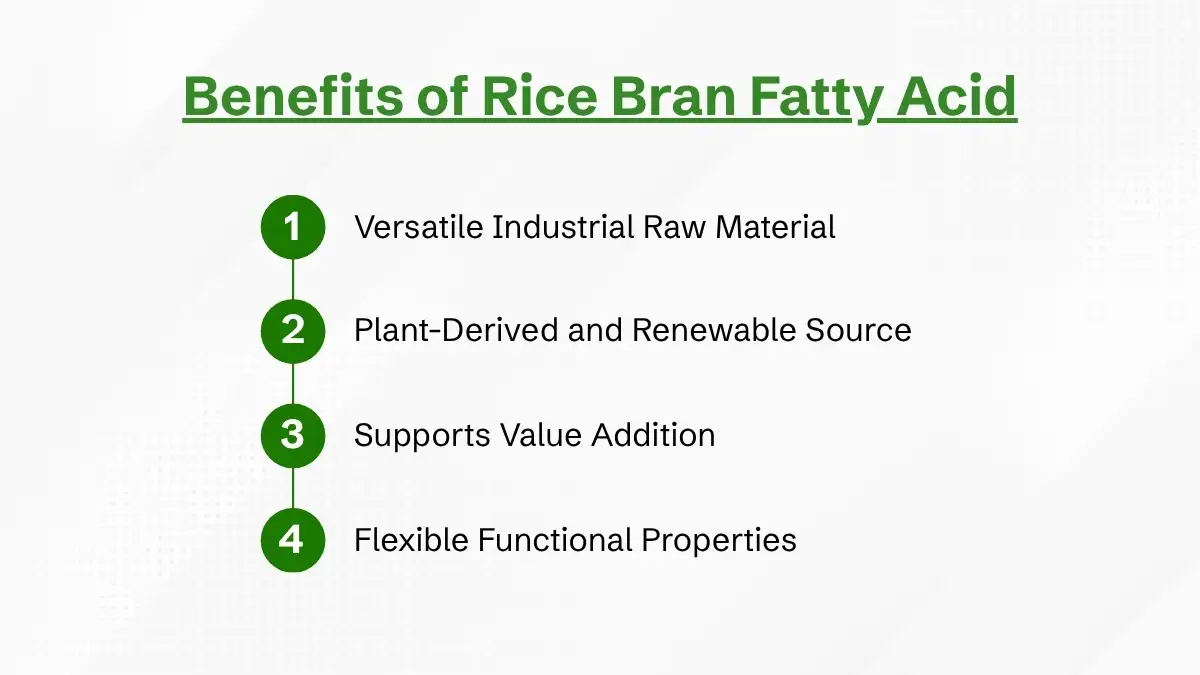
Here are some benefits os rice bran fatty acid:
1. Versatile Industrial Raw Material
Rice bran fatty acids contain multiple components useful in many industries, making them versatile. They are commonly used in soaps, detergents, cosmetics, lubricants, paints, coatings, and other oleochemical products.
2. Plant-Derived and Renewable Source
As many people are inclining to plant-derived products, rice bran fatty acids have become one of the most used sources of fatty acids. Its production also helps make better use of rice-processing by-products from every resource.
3. Supports Value Addition
Creating another product from the rice bran milling process adds value to the rice industry, reducing unnecessary waste during processing.
4. Flexible Functional Properties
The presence of saturated and unsaturated fatty acids gives rice bran fatty acids properties such as stability, lubrication, hardness, and emulsification, depending on their composition and intended application.
Industries That Use Rice Bran Fatty Acids

Here are the industries where rice bran fatty acids are mostly used:
1. Soap and Detergent Industry
Rice bran fatty acids help provide the desired hardness, cleansing properties, and texture in soaps, detergents, and other cleaning formulations.
2. Cosmetics and Personal Care
Fatty acids are used to create creams, lotions, soaps, and other personal care products. They help with product texture, consistency, and emollient properties.
3. Oleochemical Industry
The oleochemical industry uses rice bran fatty acids as a feedstock for producing various value-added chemicals and derivatives. Its composition makes it suitable for manufacturing specialty ingredients for different industrial applications.
4. Lubricants and Greases
They are used as raw materials in lubricants and greases, providing lubricating and stability properties that can support product performance.
5. Paints and Coatings
Fatty acids help with flexibility, dispersion, and other functional characteristics in paints, coatings, resins, and surface treatment products.
6. Animal Nutrition
They are also used in animal nutrition based on their specifications and intended use. They are used based on their suitability for factors such as purity, composition, and applicable feed standards.
Factors to Consider When Choosing Rice Bran Fatty Acid
But before buying rice bran fatty acids, here are some points to consider:
- Fatty Acid Composition: Check the composition and consistency of key fatty acids such as oleic, linoleic, palmitic, and stearic acids.
- Purity: Ensure the product has a suitable level of purity and minimal unwanted impurities for your intended application.
- Moisture Content: Low and controlled moisture helps maintain product quality and storage stability.
- Consistent Quality: Choose a supplier that maintains consistent specifications and quality across different batches.
- Processing Standards: Check whether the manufacturer follows controlled processing and quality-control procedures.
- Required Certifications: Verify relevant quality, safety, and industry certifications based on how the product will be used.
- Packaging and Storage: Ensure the product is properly packaged and stored to protect it from moisture, contamination, heat, and oxidation.
- Production Capacity: For bulk requirements, confirm that the manufacturer can deliver the required quantity on time.
- Supplier Experience: Consider the manufacturer’s experience in rice bran processing and its ability to meet specific industrial requirements.
- Technical & Customer Support: A reliable supplier should provide product specifications, documentation, and assistance with application-related requirements.
- Price and Overall Value: Compare pricing, quality, consistency, logistics, and supplier reliability rather than choosing solely on the lowest price.
Conclusion: Rice Bran Fatty Acid
Rice bran fatty acids are a powerful ingredient that is used in many industries, including soap and detergent, cosmetics, lubricants, paints and coatings, and other oleochemical products. Their main role is to provide shape, texture, lubrication, and grease to the product.
But when choosing rice bran fatty acids for your business, it’s important to consider some details: their composition, purity, quality, and many others, as mentioned above. If you are looking for a trusted supplier and manufacturer of rice bran fatty acids, then SVR Gaia is the right choice to fulfil your needs. Contact SVR Gaia today to get the best quality rice bran products!
FAQs: Rice Bran Fatty Acid
1. Is rice bran good or bad?
Ans: Yes, rice bran is good for health as it is a by-product of rice.